
Time to rebalance the wings: Asset management as the missing pillar
SECTOR REPORT: ISLAMIC ASSET MANAGEMENT
Time to rebalance the wings: Asset management as the missing pillar
The relationship between banking and capital markets can be likened to the two wings of a bird: each must function in harmony for the bird to fly. If one wing is underdeveloped, the flight becomes unstable. For many economies—especially in the Islamic world—the banking wing is relatively strong, while the capital markets wing remains weak. This imbalance constrains growth, innovation and wealth creation.
Review of 2025
Capital markets are not merely channels for financing what is already 'bankable'; they are platforms to fund the unbanked, the novel and the bold ideas that may lack collateral or credit history but hold immense potential. Banks, on the other hand, lend only to what is proven and predictable. Dependent on short-term deposits, they face inherent maturity mismatches when funding long-term investments and often fall short in channeling savings toward the most productive uses. Bank financing also tends to be procyclical—expanding during booms and contracting during downturns—and thus cannot, on its own, sustain robust economic development.
Yet great breakthroughs—the disruptive firms and the scale-ups—require patient capital, long-term horizons and a willingness to embrace risk. Without that, meaningful innovation seldom happens. In many Islamic economies, the innovation gap is evident: there are talented individuals and entrepreneurial minds, but too few mechanisms to mobilize capital toward their ideas. There is ample liquidity, yet much of it flows into low-risk, low-growth assets such as real estate or Sukuk—limiting both wealth creation and economic dynamism.
When banking dominates, a pause in credit can halt the economy. But when capital markets are active, economic activity continues. In the US, one key reason for higher GDP per capita lies in its mature asset management industry and diversified capital markets. The widening gap between the US and Europe in wealth creation also reflects differing levels of capital market participation and asset management depth.
VC investments also play a crucial role in wealth creation. PE firms go beyond providing growth capital: they execute turnarounds, transforming inefficient companies into productive and competitive entities. Such dynamism remains underdeveloped across most emerging Islamic markets.
Opportunity and Challenges
According to The London Stock Exchange Group, the global Islamic banking industry reached around US4.3 trillion, yet Islamic asset management primarily through funds represents only US308 billion, equivalent to about 7% of Islamic banking assets. While in the US, asset management is more than twice the size of the banking sector.
Likewise, the global asset management industry surpasses US$148 trillion, making the Islamic segment a mere 0.2% of the global total. Considering that Islamic economies account for a far higher share of global GDP, this gap signals enormous untapped potential.
Several factors explain this weak positioning: a shortage of Shariah compliant products and asset management institutions, limited market depth, low investor literacy and short investment horizons. To move beyond banking-led growth toward genuine, capital market-driven development, the Islamic world must shift from low-risk, low-return instruments to higher-potential, higher-impact asset classes. This requires stronger partnerships with global asset managers, adoption of digital wealth platforms and robo-advisors and broader retail access through multi-asset funds.
Launching multi-asset Islamic funds can serve as a behavioral bridge, allowing conservative investors to gradually engage with capital markets before venturing into more sophisticated vehicles. Similarly, robo-advisors and digital wealth platforms can enhance scalability, reduce costs and broaden participation.
Islamic asset managers must cover the full spectrum of investment classes—public equities, PE, VC, private debt and even crowdfunding. The transition from a narrow, banking-centric financing model to a broad capital markets ecosystem is essential. Collaboration with global institutional investors, established fund houses and cross-border platforms will accelerate both innovation and capital flows. Finally, banks' wealth-management divisions play a crucial role: they should not only distribute but also advocate for Islamic capital-market products, guiding clients toward diversified, goal-based portfolios.
Preview of 2026
In the year ahead, as fixed-income returns diminish, a larger share of Islamic assets is likely to flow toward riskier but higher-potential markets both public and private. The universe of Islamic ETFs and thematic mutual funds is expanding, and this trend should accelerate in 2026.
During this transition period, developing products tailored to the needs of the new generation of high-net-worth investors is essential. Reflecting their growing financial sophistication, PE and private debt-based investment funds are gaining prominence. Indeed, as fixed income returns decline, risk appetite is expected to rise.
Digital investment platforms and robo-advisory tools will further integrate retail investors into Islamic capital markets, democratizing access to professional asset management. The next phase of growth will depend on how effectively the industry leverages technology to align Shariah principles with innovation and inclusion.
The Case of Turkiye
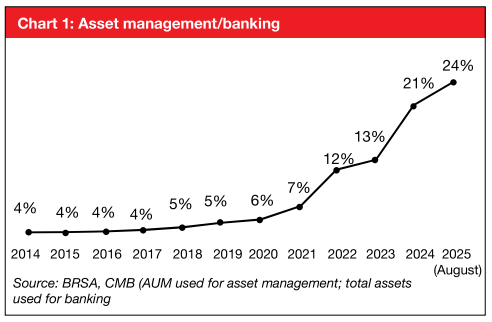
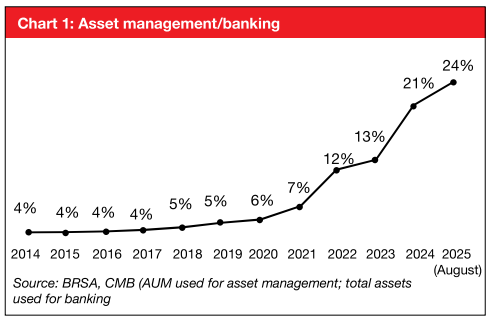
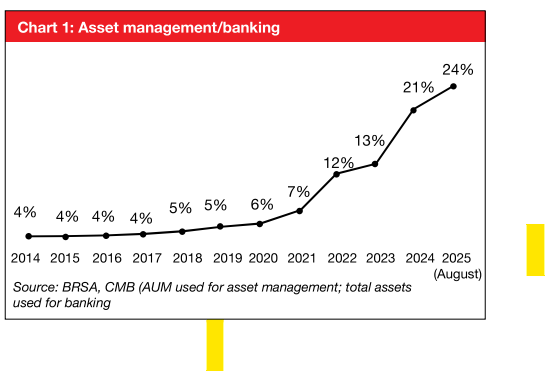
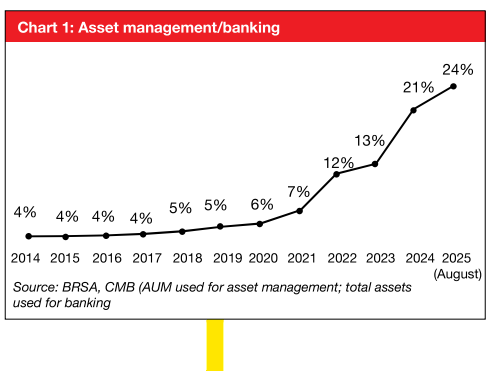
Turkiye presents a microcosm of this broader dynamic. Its banking system is relatively advanced, yet its equity, venture, private debt and wealth management markets remain under-scaled. However, recent progress in the asset-management sector including the rise of new thematic and diversified funds as well as digital distribution models demonstrates how quickly transformation is possible. Turkiye's hybrid position between Europe and the GCC gives it unique potential to act as an innovation hub for Islamic asset management.
Conclusion
The bird of economic growth must fly using both wings: banking and capital markets. In many economies, one wing remains underdeveloped. For Islamic finance, the opportunity lies in elevating the capital markets wing through asset management – diversifying instruments, embracing innovation, forging partnerships and shifting focus from mere preservation to wealth creation.
If banking provides stability, asset management provides lift – the upward force that can enable the Islamic finance bird to soar higher, more sustainably and with a clearer sense of purpose.
Author: Dr. Bayram Veli Salur (Chief Investment Officer at Kuveyt Turk Portfoy)
December 2025


 Foreign Share Stocks
 Precious Metals
Precious Metals
Precious Metals